
Saplings: Unstable Ground
Part II, a study of founders’ home lives and parental patterns.

José Ferrera wanted his money. A week earlier, the farmhand had labored in the orchards of Luigi Giannini, picking fruit. Though he’d received some payment, he’d been stiffed by a dollar. Or, at least that was his story.
On August 14, 1876, he traveled back to the Giannini farm with a shotgun in hand. Perhaps Ferrera had only wanted to scare Luigi, but as their voices rose near the Giannini family home, he raised the barrel and killed the man.
A few paces away stood a six-year-old Amadeo Giannini. As Ferrera fled, the boy rushed to his father’s side. There was nothing he could do.
The evening of Luigi’s funeral, after the house had emptied, Amadeo’s mother, Virginia, held her son and explained that the world, and his place in it, had changed. “This is the last time I take you on my knees. From today, you are the man of the house.”
It was in such circumstances, freighted with responsibility, attuned to mortality, that Amadeo grew up, eventually becoming one of the most important entrepreneurs of his era. In 1904, he founded the institution that would become Bank of America.
Not all great entrepreneurs endure such tragedy in early life. But a large number of those studied were born or raised amidst real instability, real turmoil, whether that meant the death of a parent or sibling, sudden shifts in material fortune, or frayed familial dynamics. From a young age, these children learned that life could be fickle and cruel, that one’s hand could change suddenly, and, perhaps, that the remedy was to happen to life rather than allow it to happen to you. In Part II of Saplings, our study of the early lives of legendary founders, we focus on the home, and the inherited stresses that recur most frequently.
Early loss. Many entrepreneurs become acquainted with death early, losing parents or siblings. This shortens their childhood, disrupts the family dynamic, and produces a deep sense of mortality.
Disappointing fathers, dynamic mothers. When entrepreneurs were raised with two parents, often one has a much greater influence. A relatively common pattern is for the father to disappoint, while the mother provides support and drive.
Earned love. The withholding of approval from a parent is common. In some instances, a parent does not merely withhold affection, but actively doubts their child’s worth or ability. In either variation, this seems to produce a strong desire in the child to over-prove their ability or worth to compensate.
Status in motion. Rather than entrepreneurs clustering in certain economic classes, the dominant pattern is change. Founders often lived through shifting fortunes, viscerally experiencing the mobility of status.
Imposed mythologies. Often, entrepreneurs are burdened with a family’s expectations. They are tasked with redeeming past failures, restoring a lineage, or justifying the sacrifices of parents and siblings. From an early age, identity and destiny is thrust upon them.
Though noted in previous editions of this series, Saplings does not purport to explain everything about the individuals featured, or imagine that its observations are necessary to achieve entrepreneurial greatness. It does not attempt to make statistical observations or generalize across these populations. Rather, it is an accounting of the common patterns I find most meaningful, accompanied by my interpretation of them. Across the series, the goal is to study the formative years of extraordinary figures so as to better understand them, knowing that full understanding is not possible.
You can find Part I: Outsiders here, and a discussion of our methodology here.
Early loss
Across the sample population, death visits with such regularity that you are forced to remind yourself: these were different times. Many of the founders studied were born before the 20th century or in less stable geographies. To lose a sibling in 1850s New York or a parent during China’s Great Famine was simply much more common than it would be in the San Francisco of the 1990s. It may not have made a child feel quite as different from their peers perhaps or quite as alone. But there is no reason to imagine it would have hurt less. Their home life was still changed irreparably, perhaps more so than in modern contexts.
Even adjusting for the different risks of other eras and locations, it is striking how many of these entrepreneurs lost a parent early. Stan Shih (Acer), Amadeo Giannini (Bank of America), Larry Hillblom (DHL), George Eastman (Kodak), Fred Smith (FedEx), Jerry Yang (Yahoo), Carlos Slim (América Móvil), Jorge Paulo Lemann (3G Capital), Aristotle Onassis (Olympic Maritime), Harland David Sanders (KFC), James Dyson, Lorenzo Zambrano (CEMEX), Jim Casey (UPS), Li Ka-Shing (CK Hutchison), Frank Lowy (Westfield), Alfred Krupp all lost parents in childhood or adolescence. Konosuke Matsushita (Panasonic), Howard Hughes, Wang Chuanfu (BYD), Coco Chanel, and Leonardo Del Vecchio (Luxottica) were literally or functionally orphaned. Many more lost a parent in early adulthood.
This is to say nothing of the siblings lost. John Rockefeller, Enzo Ferrari, Milton Hershey, and others all lived through the death of a brother or sister.
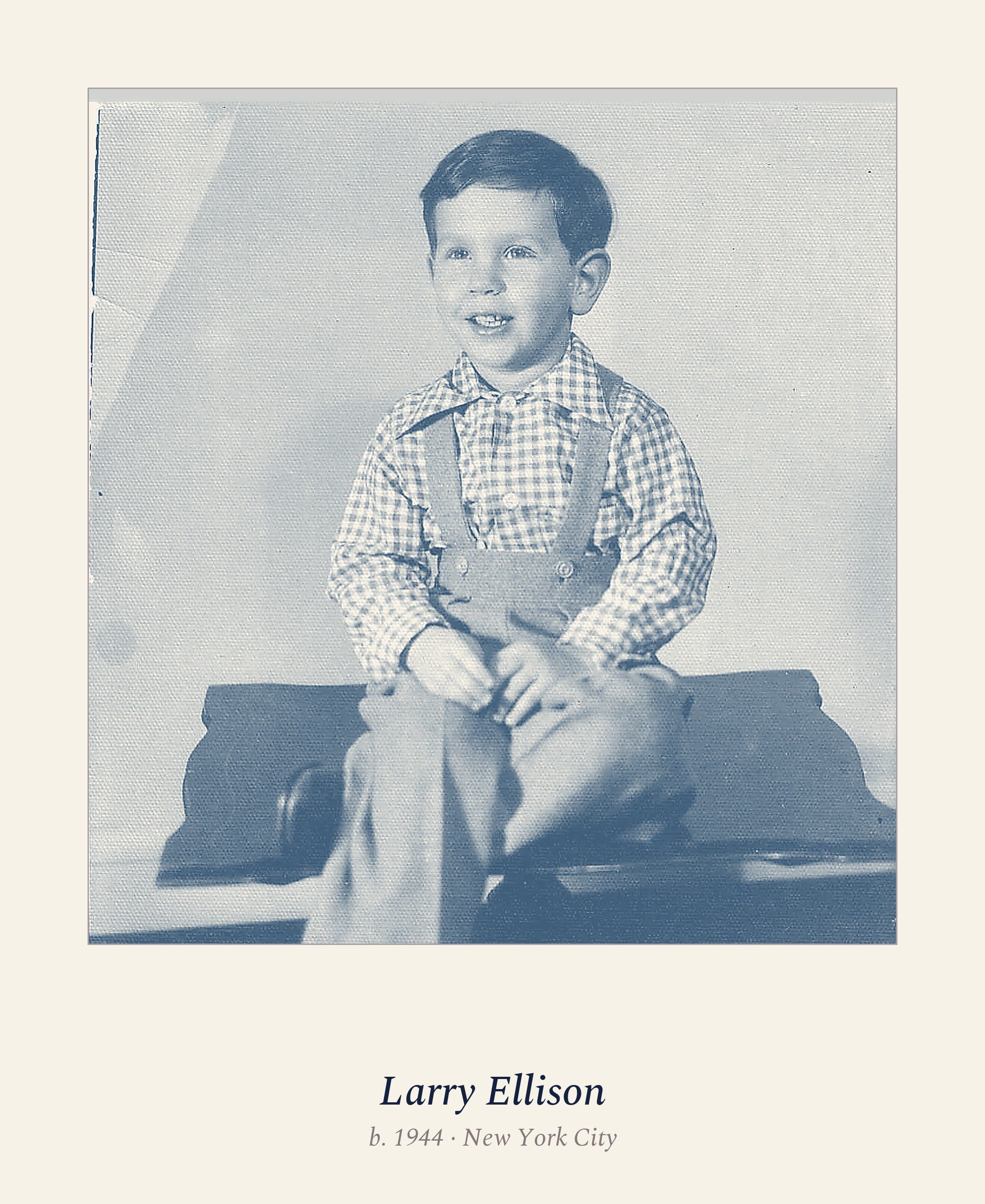
Larry Ellison experienced a stranger kind of destabilization. Over dinner one night, when Ellison was around twelve years old, his parents shared a piece of trivia: he was adopted. “That was it. They didn’t give me any details,” Ellison reported later. “It was like ‘Tonight we’re having meat loaf, and, by the way, you’re adopted.’” Ellison did not contend with the death of a parent, but in an instant, the narrative of life that stood beneath his feet was ripped away.
As with Amadeo Giannini, for many founders, the death of a parent results in inheriting the deceased’s responsibilities. Jorge Paul Lemann was fourteen when his father was struck down by a streetcar. Immediately, he is described as becoming the “man of the house.”
Li Ka-Shing, founder of the conglomerate CK Hutchison, was given similar instructions. As his destitute father lay dying of tuberculosis, he told his fifteen-year-old son that “a man must have ambitions.” With tears running down his cheeks, Li made a promise: “Father, don’t worry. I will learn to do business and make lots of money.” Within three years, young Li had gone from sweeping factory floors to a star salesman, bringing in more money than his family needed.
In such instances, it’s evident that the parental death serves as the beginning of a quasi-adulthood, carrying with it greater expectations and ambition. It pushes the bereaved child to enter the wider world earlier and to rely on themselves.
It may also create a certain obsession with mortality. Ted Turner, founder of CNN, was tormented by his father in life (discussed in Part I) and death. When Ted was twenty-four years old, his father agreed to sell a chunk of his business, then committed suicide the next day. It was up to the younger Turner to undo the sale and right the ship.
Even as Ted Turner outstripped his father commercially, he remained fixated on his demise. “He talks about death incessantly,” a friend of Turner’s remarked. “Over the years, killing himself was a high-priority topic of conversation. Most of the time he was flippant about it. He would talk in this joking way about how, if things did not work out, he could always sell the business, how all he needed was a roof over his head and some food. Then he would say, ‘If things get really bad, I can always kill myself.’ He could not go several days without talking about suicide.”
If there is an upside to an obsession with mortality, it may be that it creates internal urgency. If you understand, deeply understand, that life can end at any moment, you may be more predisposed to make the most of one’s own. To take greater risks, to drive a little harder, to push to leave something tangible behind.