
Saplings: Outsiders
Part I of our series studying the early lives of extraordinary entrepreneurs.

By the end of his life, Henry Luce was at home in any room. Not loved, of course. His strong opinions, a staunch conservatism and a fervent anti-communist bent among them, hardly earned universal approbation. But he appeared unfazed, unperturbed, more than a little superior. “He lived well above the tree line on Olympus,” one of his editors remarked. Fundamentally, at home.
As the founder of Time, Fortune, Life, and Sports Illustrated, Luce had met the good and great of every industry. And not merely met them, but shaped their lives. That had propelled him not just to eminence but extraordinary wealth. In 1966, Luce’s holdings generated $503 million. He’d founded the company 43 years earlier with $86,000.
He died the year after, aged 68, leaving behind the trappings of the Great Man, the consummate insider.
Whether the man ever felt that solidity, that sense of ultimate belonging, only he could have answered. The boy, the Luce of five and nine and fifteen, did not. No matter where Luce went, he did not fit, did not belong. First, he was the son of a missionary in Shandong, an American in China. Then, after he was sent to the China Inland Mission school at Chefoo, he was the American among English students. Worse yet, he was a stammerer, a tic he’d acquired the year prior and that his tutor had declared “absolutely imaginary” and an “evil habit.”
“Everything is going as usual but not very well,” Luce wrote in a letter home from Chefoo. “It sort of seems to hang on not in spells of homesickness but a hanging torture, I well sympathise with prisoners wishing to commit suicide.” He was ten years old, precociously articulate, and utterly alone. “I am getting that hatred of which I will never get over even tho I was here hundreds of years.”
In tandem with Luce’s suffering, a commensurate competitiveness emerged. In other missives, he writes of his desire to destroy his peers. “My years ambition has been accomplished, that is to lick Hayes.... For this year I have made the form record in going up places, that is 8 places.” A sense of deficiency seemed to give way to obsessive self-comparison and ferocious drive.
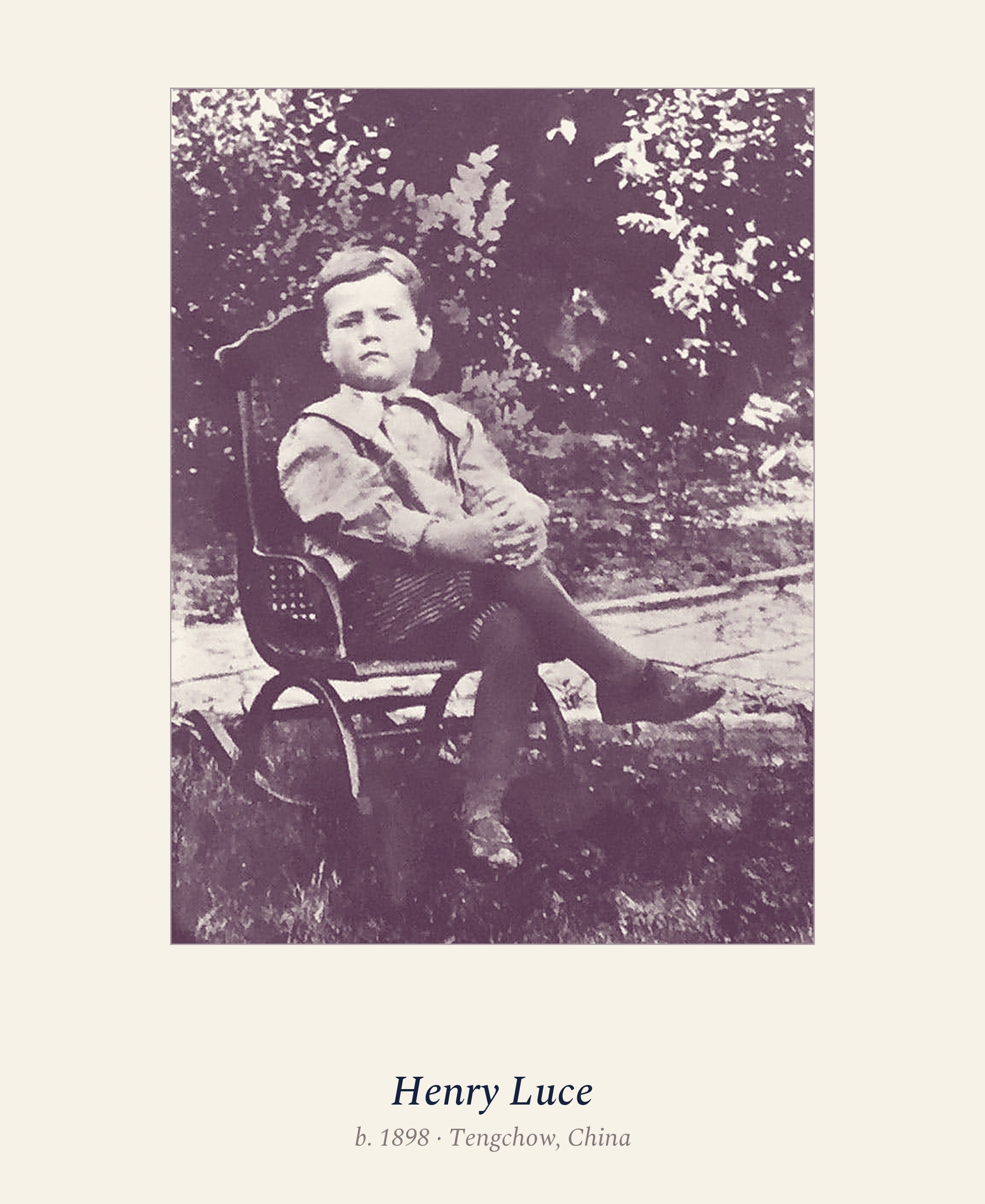
At fifteen, Luce was sent to boarding school in Connecticut, attending Hotchkiss. Yet again, he was a child apart, an “aid boy” among New England’s blue bloods. As a condition of his scholarship, he had to wait tables in the dining hall, serving breakfast to his paying classmates. Rather than living on campus, he was sent to a boarding house a mile away. He knew little of American life (“I did not know a single rule of football when I came here,” he said, wore shabby clothing fabricated in China, and his halting speech was devoid of the Yankee idioms. He earned the nickname “Chink.” He had gone from an American boy in China to a Chinese adolescent in America.
Luce’s response to serving the richer students was not to disdain them, but rather to aspire to join them. Instead, he looked down on the scholarship boys, assuming himself to be their superior. “These scholarship fellows here are all fundamentally fine, but they lack certain qualities — especially noticeable at table — that one misses!” Rather than find acceptance within a group, Luce chose to separate himself from it, to set his sights on ascending America’s social ladder. He achieved it.
Not every founder was ostracized quite as totally as Luce. Culture, class, geography, and even his manner of speaking conspired to separate him from his peers. But the experience of being an outsider, of being profoundly out of place, is the most common trait observed from studying the formations of great entrepreneurs. It is also among the most acute, contributing to a desire to prove one’s relative worth and breeding a sense of specialness, even if reflected through a dark mirror. Perhaps every adolescent feels some moment of difference; this is the beginning of selfhood. But not everyone experiences it quite like this.
Part I of the Saplings series, which studies the early lives of legendary founders, explores this quality, its variations, and its impact. As follows:
A world apart. We discuss the ways in which differences in nationality, ethnicity, class, and other external factors make these children feel like outsiders. Often, this seems to be coupled with a commensurate desire to overprove one’s worth to the rejected environment.
Familial interlopers. In some cases, children are strangers in their own homes. They’re shunned by parents and siblings, or perceived as somehow alien, which influences a sense of independence.
Isolated by their body. Illness, disabilities, and deformities impacted some founders similarly, separating them from their peers physically and forcing them to spend more time in their own minds.
Wired differently. Having a mind that runs on unusual tracks distances many founders from those around them. They often struggle to communicate, finding it easier to demonstrate their abilities and intelligence in other ways.
From the other side. Negative transformative experiences, like a close familial death, force children to grow up early and contribute to a sense, in some cases, of being somehow special.
It is worth noting that neither this series in general nor this piece in particular imagines that it can explain everything about these people. To notice that so many remarkable founders were marginalized by the world around them in their early years is not to say that it is a necessity of greatness or to draw a direct correlation between exile and achievement, nor to valorize the very real, often terrible suffering these people endured. Humans are capable of metabolizing hardship into many things — helplessness, energy, cruelty, inspiration, revenge, and grace—none of which ennoble the original sin.
And, of course, every case is a matter of degree and a matter of perspective. Only the founders themselves could tell us how they perceived their remove from the world around them, and given what unreliable narrators these characters often are, you would be a fool to take them at their word. (“I’m super normal” is Jensen Huang’s self-appraisal.) This is, then, just a fragment of something, a sliver of colored glass we are putting up to the light to look at the shadows it casts.
If you are interested in the broader process behind the Saplings project, you might enjoy our piece introducing it here.
A world apart
A young Masayoshi Son, Softbank’s flamboyant impresario, considered his grandmother “repulsive.” This was the woman who raised him and loved him. The son of Korean immigrants in Japan, the Son family had little money. Each morning, the elderly woman placed a tiny Masayoshi on a two-wheeled wooden cart and pulled him through the neighborhood, through dirt and pig slop, to see what food the restaurants near the train station had discarded the night before. This was what they fed the family pigs. Son recalled the scene as an adult, describing the “slippery” ground and its “rotting smell.”