Infinite Games
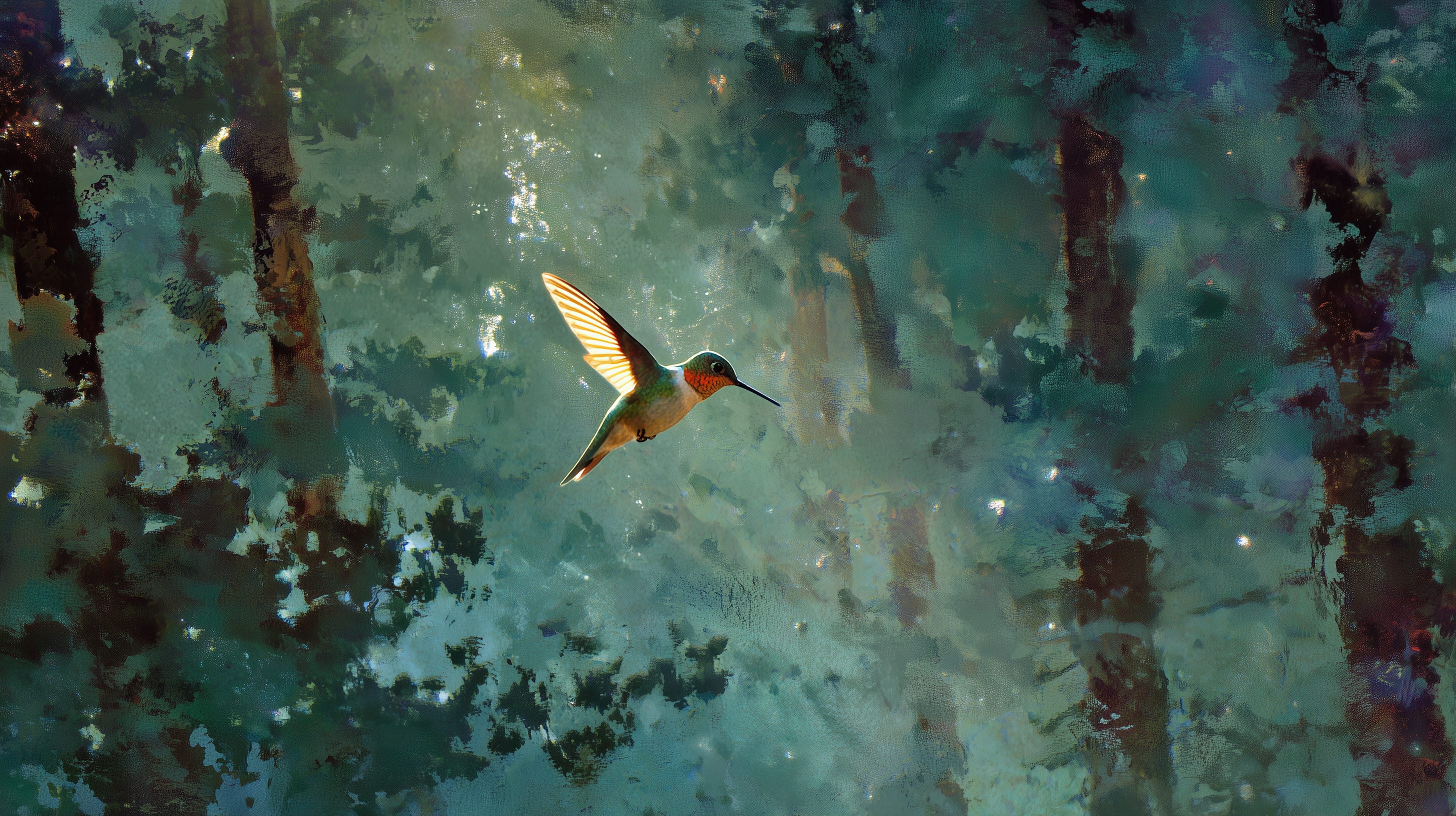
Joining the Hummingbird partnership.
“To be prepared against surprise is to be trained. To be prepared for surprise is to be educated.”
- James Carse, Finite and Infinite Games
Friends,
Evolutionary biology has the concept of “allopatric speciation,” the process that occurs when a species develops separately from those on the mainland. Saved from some evolutionary pressures and exposed to others, a vole, or reptile, or bird, becomes something different. To survive and thrive, it develops different strengths. In some cases, when the species is reintroduced to the mainland, it is strangely, superbly fit — able to compete, precisely because it does so differently.
In late 2023, I published what I considered one of The Generalist’s best pieces. It covered a little-known fund called Hummingbird Ventures, which had quietly delivered some of the best returns in the asset class, despite being founded in Belgium, far from the gravitational pull of Sand Hill Road. They had done so while actively shunning the spotlight whenever it happened to search in their direction, and by taking an approach that seemed devised from scratch, free of puffery or mimicry. More than any firm I’d studied, Hummingbird obsessed — and this was not merely hyperbole, but euphemism — over the psychology of founders.
Speak to Barend van den Brande or Firat Ileri for even a few minutes, and you can feel the speciation at work. The conversation moves in unexpected directions before landing on a counterintuitive truth; a discussion of a startup is liable to shift into Dostoyevsky, the functionality of the brainstem, or Orson Welles at any moment. Martin Amis, one of the great prose stylists of the last fifty years, decried the use of “herd words” — clichés and banalities dog-eared by overuse. The tech industry is a great rancher of this herd. Sit in a Palo Alto coffee shop, and you will hear different people have the same conversation, the same version of a conversation, in an infinite loop. With Hummingbird’s partners, I found none of it.
Even after I’d finished researching the firm and published my piece, it remained a creature of strange fascination to me. An odd, iridescent species zipping across the startup landscape to its own music.
Perhaps that is why, when Barend and Firat approached me about potentially joining the firm, I surprised myself. For six years, I had built The Generalist on the conviction that I am only truly myself inside a structure of my own design. When I thought of prior versions of myself, they always seemed ponderous and hazy by comparison. Because of that, similar approaches from funds to join forces over the years had been met with an automatic refusal. But, in this instance, for the first time, a refusal did not instinctively arrive. Intuitively, I sensed that rather than being forced to fit a certain form-factor, to evolve in a specific way, Hummingbird might actually sharpen what made me different rather than sand it down.
At the start of last year, I began working with Hummingbird as a venture partner. I saw it as the right way to deepen my investing craft, learn from what I considered to be the best founder-focused firm in the world, and for both sides to discover how we might work together more deeply.
Over the past twelve months, I’ve been struck by the depth of Hummingbird’s craft and how natural the collaboration has felt. I have come to appreciate what seemed like tiny nuances in a founder’s story, ask better, more interesting questions, explore the virtues of ambiguity, and stretch my thinking in new, unusual ways. Getting to do so alongside two superlatively interesting, high-integrity thinkers has been a genuine privilege.
It is because of this that I’m glad to share that I am joining Hummingbird as a partner. I believe very strongly that it is the best long-term home for my investing practice, and that Hummingbird is positioned to be one of the dominant firms of the coming decade.
Naturally, this raises the question of what happens to The Generalist. The answer: it remains 100% owned by me, and I intend to keep building it. Writing is not only a source of endless joy but also the way I do my best thinking. My hope is that my work with Hummingbird will sharpen my analytical lens and open the door to new people and stories to share with all of you.
But the partnership has also clarified something I’d already begun to feel about the kind of publication The Generalist should become. As our profile has risen, we’ve earned the ability to spend time with some of the most interesting organizations in the world and assess them with a depth and fidelity closed to outsiders. It’s only by taking this time that we’re able to produce series like “No Rivals,” our four-part chronicle of Founders Fund. The response from all of you validated the eighteen months I spent pulling this story together – it became our most popular work by an order of magnitude.
Increasingly, these are the projects I want to test myself against as a writer. My ambition has scaled alongside the publication, such that I want to focus on the biggest possible pieces, those I feel only I can write. (Ah, the ego of the writer!) As with “No Rivals,” these necessarily take a great deal of time and effort, involving long cycles of research and reporting. But they are what tests and intrigues me most. I have spent nearly a year studying what I think may be the most important company of our era, and I cannot wait to share it with you in the coming months.
A final consideration is the current publishing landscape. It is easier than ever to spin up a Substack and, with the help of AI, begin publishing passable articles or compilations. As the median becomes ever more crowded, I believe the optimal strategy for a publication like ours is to keep pushing toward the right tail. There can be thousands of publications that write thousand-word pieces on some aspect of startup culture, but very few will succeed in writing deeply researched, long-form epics of the most consequential organizations of our era. This is the version of the game I want The Generalist to play; to borrow designer Dieter Rams’ mantra: less, but better.
Of course, we will not only publish thirty-thousand-word series. In the coming months, I have several analyses of legendary entrepreneurs to share, alongside some thoughts on the venture landscape. On balance, though, you can expect to hear from us less often, while the work we publish grows in depth and value.
I’ve been thinking a lot about an Oscar Wilde quote that Barend introduced me to. Though Wilde is best-known for his witticisms, in this instance, he is pure profundity:
“If you want to be a grocer, or a general, or a politician, or a judge, you will invariably become it; that is your punishment. If you never know what you want to be, if you live what some might call the dynamic life but what I will call the artistic life, if each day you are unsure of who you are and what you know you will never become anything, and that is your reward.”
It is, in a sense, an echo of Carse. A way of describing the value of fluidity and the importance of allowing oneself to be surprised. Over the course of my career, I have imagined many paths for myself, but the best have always felt like a mix of shock and inevitability. I would never have thought of running a newsletter, and yet, once I’d begun, it was strange that it had taken me so long. So many of the best things that have happened to the publication, to my investing, to my thinking have arrived from directions I didn’t anticipate. This is another. I look forward to sharing what comes next.

