
FTX Trilogy, Part 3: The Everything Exchange
FTX is not a crypto company.
Editor’s note: this trilogy was written in August 2021, fifteen months before FTX’s subsequent meltdown. We have kept it up to show our thinking at the time, and the view of the broader market. We reflected on the fallout and what can be learned in a coda to the trilogy, “The Casino and the Genie.”
You may want to read Part One or Part Two, first.
It feels strange to think that Amazon was once just a bookseller.
The young Jeff Bezos, a fresh defector from the hedge fund world, had studied a number of wedges before making a decision. Should his online business sell CDs? VHS tapes?
Books made the most sense. In their durability, portability, and especially variety, they were perfectly suited to be sold over the internet. It proved a sound decision.
In time, of course, Amazon became something much grander, more expansive. A place to buy almost every conceivable item — an “everything store,” as writer Brad Stone described it.
If FTX succeeds in maintaining its trajectory, we may look back on this period as the company’s “book” era. Today, FTX is mostly a cryptocurrency exchange, but that might not be the case for long.
Through conversations with leadership, investors, and crypto insiders — and access to internal strategy documents, The Generalist has developed a picture of a business that sees itself less as a cryptocurrency product, and more as a kind of “everything exchange,” a place to buy and sell, to trade, all manner of assets. Whether such a lofty goal can be reached remains in question.
In the final installment of our FTX Trilogy, we’ll unpack the four paths the company may pursue to grow its footprint, touching on feature development and M&A. In particular, we’ll discuss:
Betting on sports. Why FTX’s sponsorships may herald a greater involvement in the sector.
Expanding in crypto. How FTX could bolster its institutional and consumer crypto offerings.
Becoming a bank. FTX sees itself as a full-stack financial business — what does that mean?
Entering social media. Should FTX buy a social network? It may present the best opportunity to bulk acquire customers and mainstream crypto.
Sports: Playing in the Big Leagues
FTX’s decision to spend upwards of $500 million sponsoring the Miami Heat, MLB, and eSports team TSM, looks strange at first glance. Why would a cryptocurrency exchange fritter the equivalent of a growth round on such generic, targetless marketing? How many higher-precision avenues did the company overlook in favor of blanketing the sports world and its assemblage of fans in lucre?
If marketing is so often a game of sniping and scalpels, every decile optimized, FTX seems to be stampeding into battle with a shotgun. Indeed, why haven’t more established domestic entities like Coinbase or Gemini made similarly flashy moves?
It starts to make more sense when you consider that FTX’s approach may be targeted, after all — it’s simply aiming at a different bull’s eye: the world of sports. In the coming years, we may see FTX play in betting, tokenized contracts, NFTs, and ticketing.
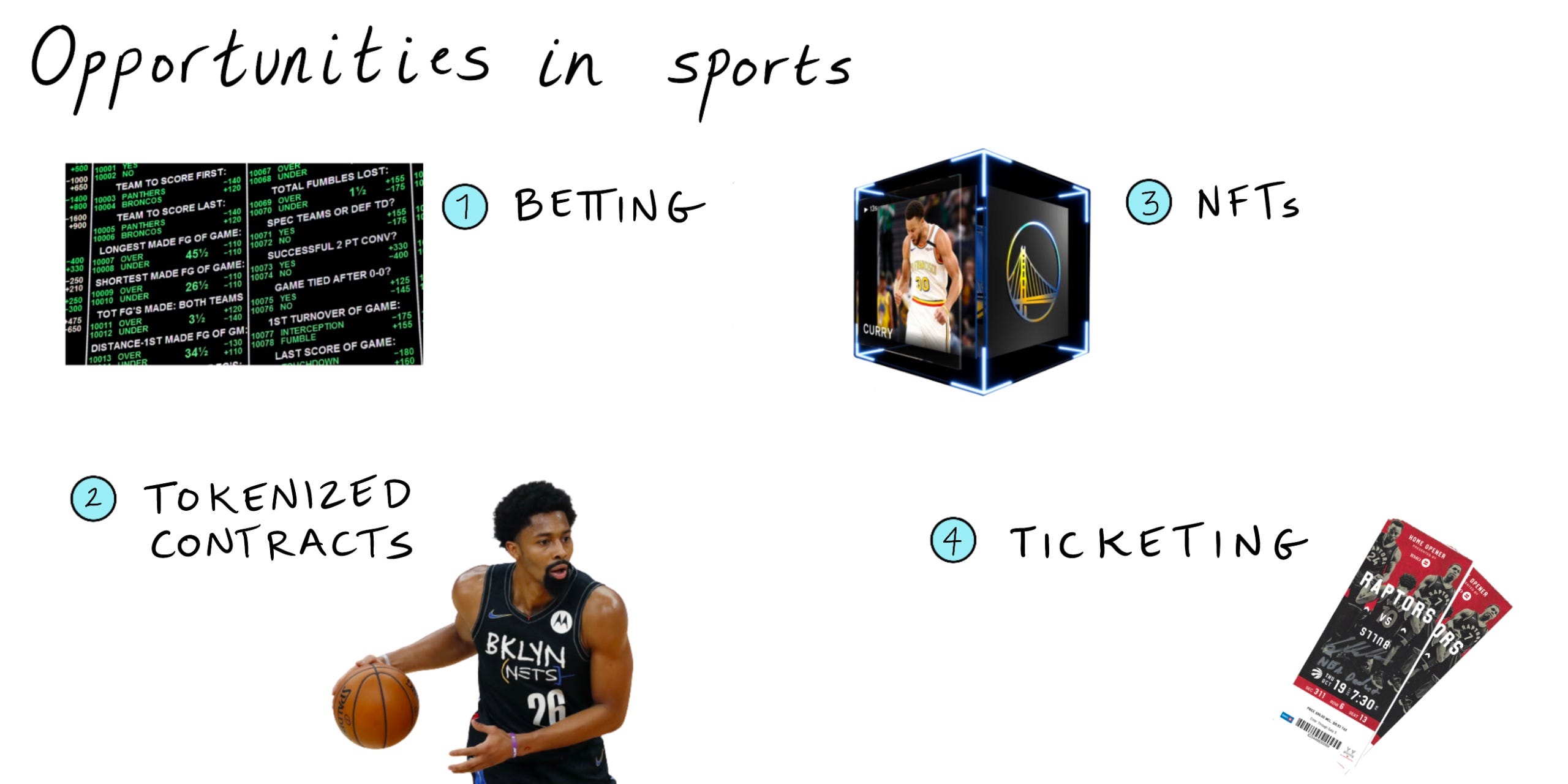
The obvious place to start? Sports betting, of course. (Both traditional and eSports.)
When I asked Sam Bankman-Fried (SBF) about FTX entering this arena, he responded economically: “Possibly.”