
Introducing Generalist Intelligence
A new weekly intelligence briefing for subscribers.

Friends,
For several years, I’ve wanted to launch a weekly intelligence briefing. While there are exceptional private intelligence groups covering the financial markets and geopolitics, and many great tech publications, I nevertheless found myself wanting something a little different from what I was able to find.
Something that delivered an elegant, insightful analysis of the hidden shifts and fresh opportunities bubbling up in our industry. Something high-signal, low-fluff, and with, perhaps, a dash of wit. Something that provides a little greater situational awareness in thirty minutes or less.
But doing it right would require taste and craft, as well as real time. For an intelligence product to succeed, it must find fresh angles on known stories and the non-obvious ones just bubbling beneath the surface. That takes scrounging and scouring.
Earlier this year, we were able to unlock both. Most important was convincing one of my favorite writers, an old hand at this kind of work, to jump aboard and lead the charge. By leveraging frontier models, we’ve been able to build an extensive signal-gathering apparatus that would not have been possible to conduct without a very large team, spanning news, industry outlets, social media, academic research, government and regulatory filings, code repositories, model-adoption aggregators, fundraising data, prediction markets, website monitoring, open-source intelligence sources, and talent flows. We also monitor a select group we refer to as “super signalers” across various verticals, selected by us, who we believe are frequently ahead of the curve. Not all of these approaches are bearing fruit yet, but we expect them to improve as we build and fine-tune. Already, we’ve seen the benefits of a process that searches so expansively. Not only does it surface tidbits a human might have missed, but it spots echoes or juxtapositions that are revealed only with capacious context.
However, the story selection and writing are done by us, the humans. The system hunts ceaselessly, bringing up a furious exhaust of data, noise, and signal, all in one. It is up to the human to think, judge, analyze, and write.
Generalist Intelligence is the result of this marriage, a weekly intelligence briefing designed for tech’s most discerning professionals. It will arrive Friday mornings. Our hope is that it opens you up to perspectives you hadn’t considered and offers a look at fresh pockets of the future you might have missed. I’ve been reading internal versions of this as we tuned the format over the past couple of months, and have found myself looking forward to it every week.
We’re in the very early stages of getting this right, and there’s a long way to go. We’d love to know what you think, especially what you’d like to see more of, as it comes up. Our goal is for this to become the highest signal-to-noise newsletter you receive each week, and one worth setting aside the time for.
Now, onto the briefing.
— Mario

With SpaceX blasting into the public markets and Anthropic and OpenAI straightening their ties to follow suit, the bajillion-dollar question is, obviously: are they worth it? Anyone claiming to know the answer very likely has a bridge to sell you. Nevertheless, we can’t stop thinking about it.
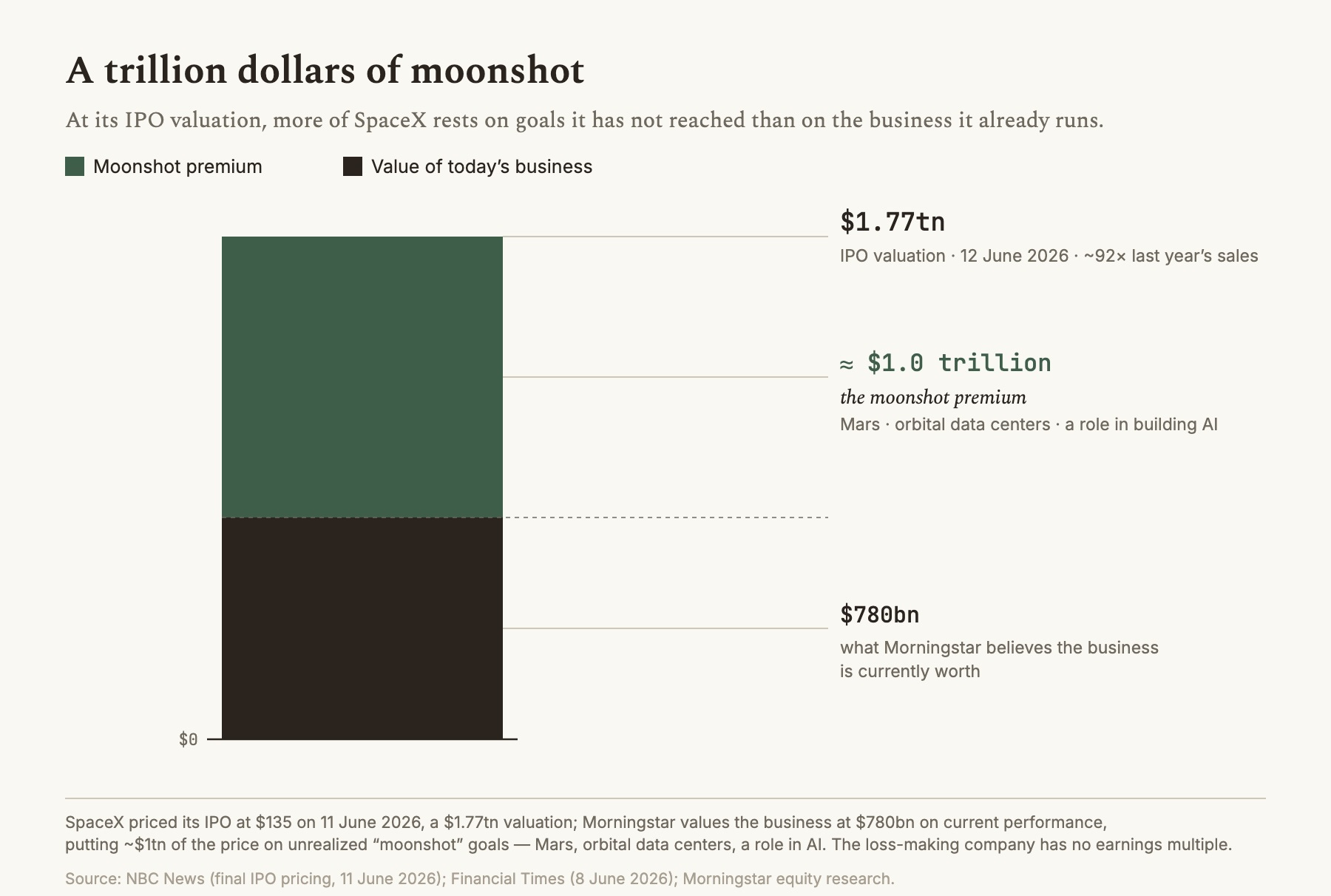
SpaceX feels like a special case. Public markets are being asked to price in total interstellar domination at IPO, with a good trillion of the $1.77 trillion price tag – at which the loss-making company would trade at over 90x last year’s revenue – based on a series of highly speculative goals including repeat business on Mars, data centers in orbit, and making a key contribution to the development of AI. On the other hand, it’s Elon. So, you know.
What’s really got our chins wagging at Generalist Towers this week is a more existential question. Anthropic and OpenAI haven’t filed public prospectuses, but they look likely to be priced as though they are in, effectively, a two-horse race for control of the future (ok, maybe Google too). Some of us think that’s right – that it’s only a matter of time before one of the model labs cracks recursive self-improvement, and then it’s a short hop to AGI and either Sam or Dario as World King.
But a couple of things have landed in the past week that have got us thinking seriously about the other side. So we thought it would be fun to take the contrarian stance, and make the bear case for AI.
AI, huh, what is it good for?
LLMs are incredibly good at coding. At the end of last week, Anthropic dropped an essay titled When AI builds itself, in which the Claude-maker claimed that more than 80% of the code it merges into its codebase was written by Claude, and that its engineers were shipping “8x as much code per quarter” compared to their relatively flat productivity between 2021 and 2025. (When I asked Claude about this, it raised an eyebrow at the figures, pointing out they were “self-reported by a company currently raising money on exactly this story.”) And to be fair, rather gallantly, the good folks at Anthropic point out that the 8x figure is likely an overstatement as it measures “quantity over quality.” But the direction is clear: Claude is incredible at writing code. Presumably, this is translating into giant gains for all?
Well, no.
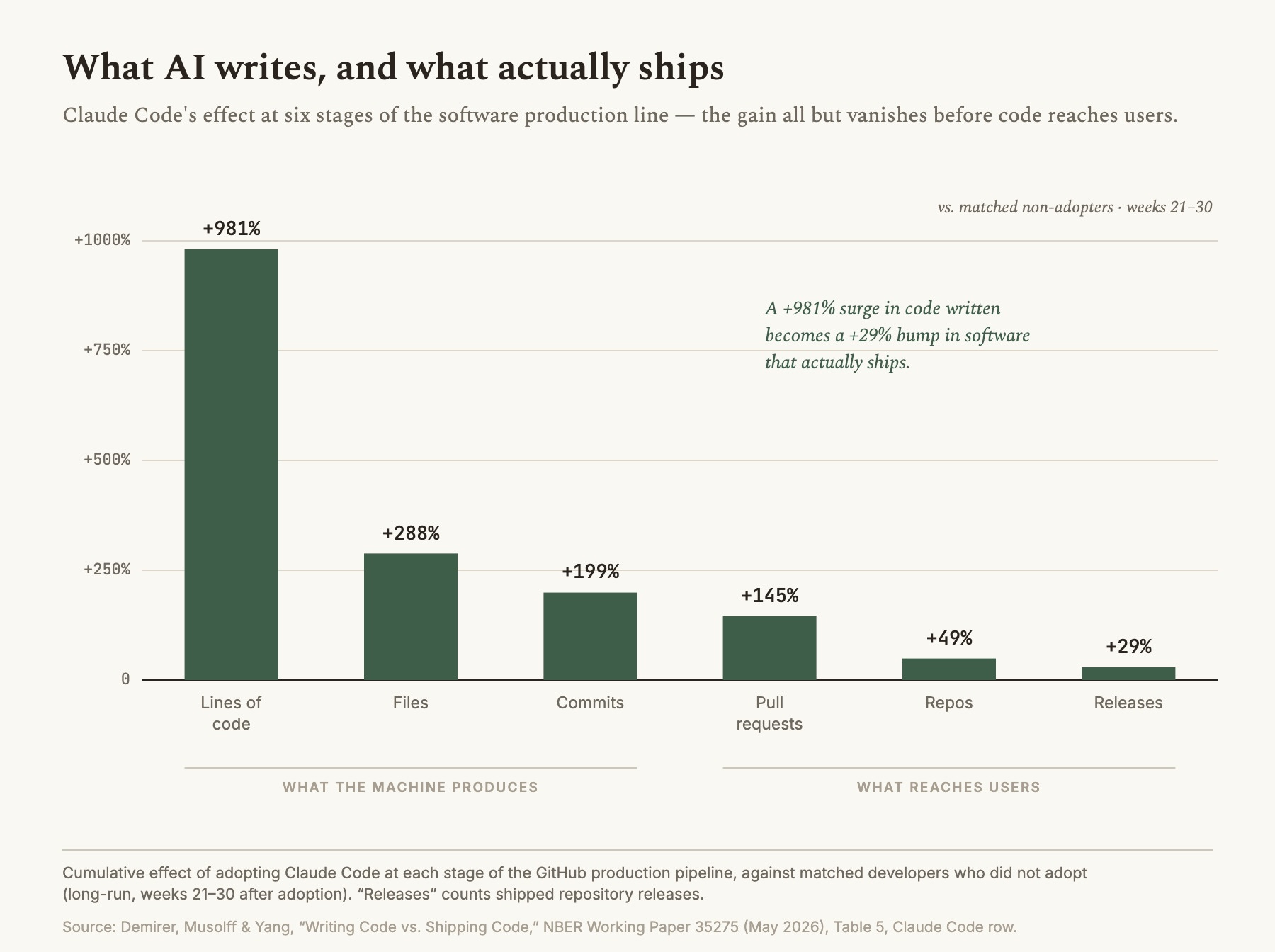
A new study of more than 100,000 GitHub developers found that Claude Code allowed coders to create or edit almost 300% more files. But that uplift was halved to 150% by the time they got to submitting pieces of work for review, and that in turn shrunk a further 5x by the time it got to shipping. In other words, coders using the latest agentic AI tools released just 30% more software, compared to those raw-dogging it. The researchers attribute that remaining 30% to what they call “strong complementarities” between the agents and the coders, meaning the agent very much needs the coder. They also noted that while there was a marked uptick in new apps being made this way, there was “no increase” in overall demand. This doesn’t mean agents are bad at code, but it does mean they might not be nearly as good as you thought at the thing they’re best at.
So what happens to the model makers?