

Friends,
You didn’t mind speaking with Hanns Scharff. No, it was better than that — you liked it. He spoke English well, for one thing, the product of years spent in South Africa and a wife from London. But that didn’t fully explain it either. He spoke softly (unlike the others), was good for a joke or a story, and when he directed his dark, thoughtful eyes in your direction, you didn’t feel fearful, but at ease.
You could almost forget that he was the Luftwaffe’s most effective interrogator. And you, his prisoner.
While the Nazi Party’s other torturers and wheedlers relied on threats and violence, Scharff found success with a more genteel approach, taking downed pilots on long walks in the Taunus hills northwest of Frankfurt, during which he seemed to avoid discussing military matters. Only later, in some cases much later, would prisoners realize what had happened.
One American pilot recalled such a stroll. Only after he and Scharff had wandered and chatted for a while did the German mention, almost in passing, that a chemical shortage seemed to have impacted American munitions: their tracer bullets now trailed white smoke rather than their usual red.
No, no, the American told him. That wasn’t caused by a chemical shortage; it was a matter of design. American tracer bullets shifted from red to white when a pilot was running low on ammunition. It was a kind of warning system.
There it was. By purposefully saying the wrong thing, Scharff prompted the pilot to correct him, all without asking a question. A pocket had been picked without the wallet’s owner even registering a rustle. The pilot would not realize what had happened until it was much too late.
This technique, and others like it, are the topic of Confidential by John Nolan, a 1999 book that is as fascinating as it is difficult to obtain. Though prized by intelligence officials and professional “elicitors,” Confidential is no longer in print and only available to buy second-hand. To grab my copy, I spent a few hundred dollars on eBay and waited weeks for it to arrive. All of which only adds to its strange allure, as if someone decided Nolan’s work was too useful to simply leave lying around.
Confidential is a wildly entertaining and impressively insightful book. In studying it closely these last few months, I’ve also come to believe it’s an important one. Though Nolan is ostensibly writing for the professional intelligence gatherer, his conversational techniques are useful to anyone, in any context. They are liable to make you more engaging and persuasive, as well as a better conversationalist.
It is also worth knowing when someone else is using them. Why did that salesperson seem to purposefully misspeak? Was I imagining it, or did that headhunter seem to disbelieve everything I said? What is it about this person that makes me want to open up so much? For founders working in sectors of national interest, Confidential will help you protect what you know. If you are building almost anything of note, there is a good chance that someone out there — whether in a bland concrete building, a glassy office tower, or a grassy tech campus — would love to understand it better than you’d like them to.
This is the second piece in an occasional series about books that change how you see everyday interactions. The first, on Keith Johnstone’s Impro, explored the invisible power dynamics in every conversation. Confidential picks up the other side of that coin: how information actually moves between people, and what a former spy figured out about making it move faster.
If you’d like to read more work like this — pieces that dig into overlooked ideas and the people behind them — a premium membership is $22/month or $220/year. Subscribe now.
Lessons from Confidential
Like a character in Atlas Shrugged, the natural question when beginning Confidential is, “Who is John Nolan?”
The first thing to say is that this is the name you would want for a spy — a vaguely heroic sound being stirred into a bowl of porridge.
There are, fittingly, few details online, so we must rely on Nolan’s own telling. For twenty-two years, he worked as a spy. From the sparse available details, it seems Nolan spent time in some of the intelligence community’s more controversial programs, a background that lends Confidential both its authority and occasional chill.
After his time working for the government, Nolan founded a corporate espionage consultancy that advised business clients and gathered intel on their behalf. (One of the only articles I can find that mentions Nolan outside of Confidential covers an espionage campaign conducted by P&G against Unilever in 2000 to obtain the “secrets of shampoo.” Nolan’s firm was ostensibly the orchestrator.)
As part of his work, Nolan’s team relied on the psychological tools he outlines to extract sensitive information — all while being perfectly explicit about who they were. Beyond his team, Nolan also trained executives to use his techniques and protect themselves against him.
Nolan’s own “call to adventure” is a memorable starting point for the book. In 1960s New Jersey, Nolan started work as a typewriter salesman for a small local outfit, competing with a rep from IBM. Despite offering a superior product, Nolan struggled to shift them. While he flailed around trying to convince companies to have him in for an appointment, his rival was having companies call him - everyone knew that if you needed a typewriter, you went to “Big Blue.”
Sitting in a coffee shop one day, Nolan watched as the IBM salesman loaded typewriters into his station wagon. “In a brief moment of clarity,” Nolan came to a realization. Why bother to hunt and scrabble for customers when he could simply follow his rival and figure out who was in the market for typewriters?
For the rest of the day, he tailed the station wagon, watching it go from office to office. The next morning, he set out and visited every company, one after another, showcasing what his product could do. That week, he sold twelve typewriters.
Over the following months, he repeated the trick, shadowing the IBM rep a few days each week. He grew cocky enough to wait outside an office building and follow him an hour later. Without meaning to, Nolan stumbled into the world of intelligence gathering and had seen what it could yield.
This is the first of Nolan’s rollicking stories, but it would be wrong to classify this as a collection of yarns. Across Confidential’s 350 pages, Nolan outlines techniques of striking psychological acuity, interleaved with lessons from the history of espionage, and detailed examples. On a given page, you’re just as likely to learn about the subterfuges Johnson & Johnson deployed to defend the Tylenol market as to analyze the brilliant sinuousness of Sherlock Holmes’s questioning style.
For this piece, we’ll focus mainly on Part I: “Eliciting the Information You Want and Need.” Though the latter two parts offer interesting details, they primarily address how organizations can collect intelligence more effectively or protect against spies.
As the title of Part I suggests, it covers the art of “elicitation.”
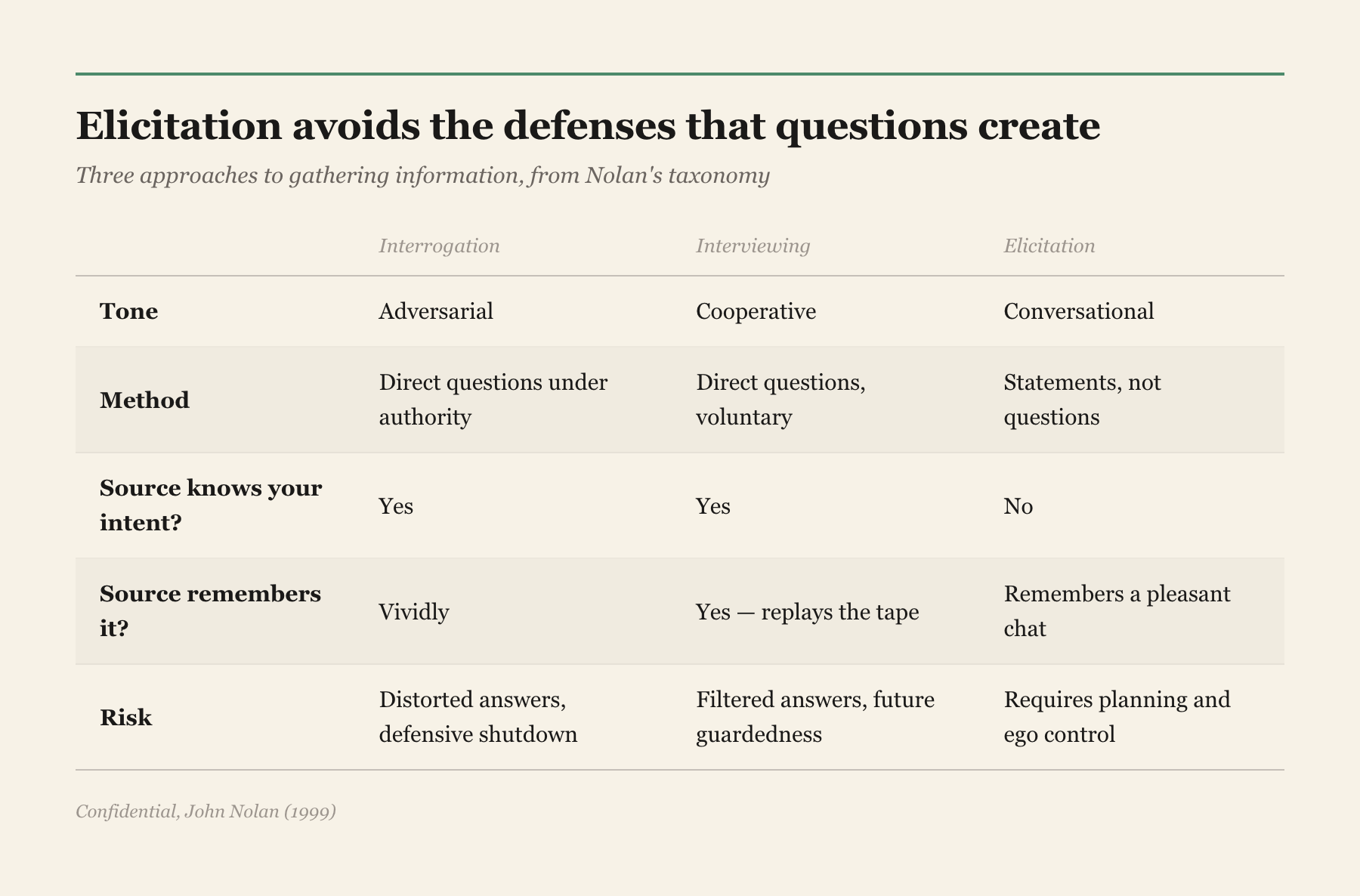
Even if you are familiar with this word, its place in the Nolan lexicon is particular and benefits from definition. When the author writes about elicitation techniques, he explicitly means the following:
Elicitation…is defined as that process which avoids direct questions and employs a conversational style to help reduce concerns and suspicions—both during the contact and in the days and weeks to follow—in the interest of maximizing the flow of information.
As Nolan explains, elicitation is expressly distinct from interrogation and interviewing. “Interrogation [is] obtaining what you want from someone who possibly has it, who has not admitted to having it, and who knows who you are and why you want it,” he writes. Meanwhile, “interviewing is the process of obtaining information from someone who probably has it, who has more or less admitted to having it, and who knows who you are and why you want it.” Interrogation is, by definition, adversarial, while interviewing tends not to be.
As you’ll see, elicitation is a subtler dance.